The Kneeler’s Quiet Arithmetic: Stitches, Saints and the Ordinary Work of Prayer
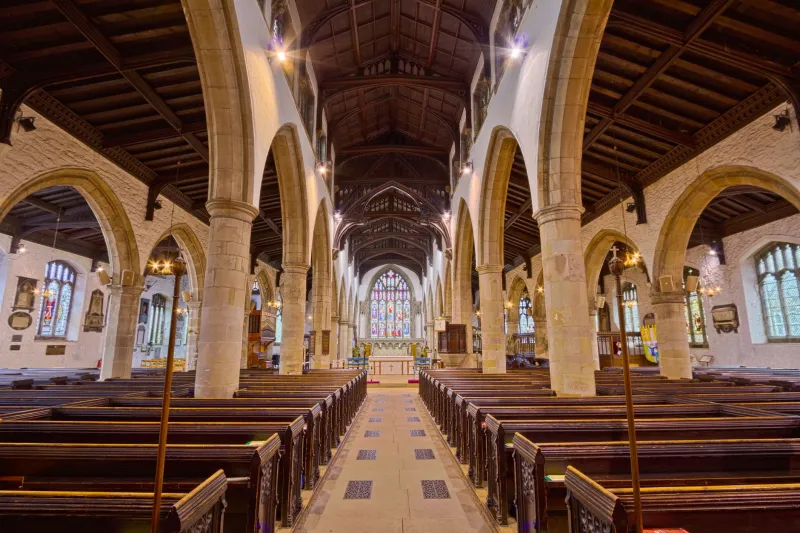
At the back of many parish churches, in a cupboard that smells faintly of beeswax and old hymn books, there lives a stack of kneelers. They are not usually counted among a building’s treasures. The font may be Norman, the pulpit may be Victorian, the east window may have survived a reformation or a war, but the kneelers are simply there: faded, stacked, slightly worn at the edges, waiting for the next service. Yet look closely and they begin to behave like tiles. Each one is small, distinct, set beside its neighbours, and together they make a floor for prayer.
The Small Tile and the Whole Floor
St Paul’s language for the church is not, at first glance, a language of soft furnishings. In Romans 12 he speaks of bodies, members, gifts and sacrifice. In 1 Corinthians 12 he returns to the same image: one body, many members, each with a different function. The point is not uniformity but coherence. The eye cannot say to the hand, ‘I have no need of you.’ The embroidered kneeler cannot say to the plain one, ‘You are not part of the pattern.’
A pew-level mosaic works in the same way. No single kneeler tells the whole story of a congregation. One may carry a lamb, another a cluster of grapes, another a simple cross worked in crimson thread. One may be precise and formal, another slightly crooked because it was made by a beginner. Set them side by side and they form a kind of visual catechism: creation, incarnation, sacrifice, resurrection, local memory, quiet hope. The whole floor is not one design. It is a company of designs held together by use.
Patterns That Carry a Parish
Needlepoint and cross-stitch have long been domestic arts, and the patterns found on kneelers often migrate from home to church. A maker may adapt a motif from a magazine, a sampler, a grandmother’s cushion or a diocesan pattern book. Wheat and grapes appear because they speak of the Eucharist. Fishes and lambs recall early Christian symbols. Local churches, bridges, lighthouses and ploughs appear because the parish is not an abstraction. Initials and dates appear because someone wanted the work to be accountable.
This is where the kneeler becomes more than decoration. It is a small artefact of belonging. The pattern may be repeated across twenty kneelers, but the hand that worked it was not a machine. Tension varies. A thread runs slightly darker where the wool was dyed in a different batch. The canvas may pucker. These are not failures; they are evidence of an offering. In a culture that prizes the flawless and the mass-produced, the kneeler quietly insists that the ordinary work of ordinary people can be set apart for prayer.
Dedications and the Communion of Saints
Turn a kneeler over and you may find a small label, a stitched initials, or a brass plaque fixed to a wooden frame. ‘In loving memory of…’ ‘Given by the Mothers’ Union…’ ‘To the glory of God.’ Such inscriptions are a form of local hagiography. They do not make the deceased into stained-glass saints. They simply place a name in the company of the praying church.
The communion of saints is often preached as a great cloud of witnesses, and rightly so. But at pew level it becomes concrete. A woman kneels on a cushion stitched by someone she never met. A child traces the outline of a dove with a finger while the congregation says the Creed. A visitor from another country finds, in the back of a Lincolnshire church, a kneeler worked in a pattern her own mother once used. These are not sentimental accidents. They are signs that the church’s memory is carried not only in doctrine and architecture but in the patient handiwork of the faithful.
Romans 12 speaks of offering the body as a living sacrifice. The kneeler is a modest reminder that bodies kneel, hands fold, knees ache and prayers are said in particular places by particular people. 1 Corinthians 12 speaks of members who seem weaker being indispensable. The same is true of the hidden hours spent stitching a cushion that most worshippers will use without noticing. The church is sustained by labour that is not performed for applause.
The Hidden Hours
There is an arithmetic to a kneeler that few congregations ever count. The design, the tracing, the stretching of canvas, the choosing of wool, the hours of stitching, the blocking, the finishing, the dedication, the placing. Multiply that by forty kneelers and you have a quiet economy of devotion. It is the kind of economy that does not appear in a parish annual report, but it shapes the room in which the report is read.
This hidden labour teaches something important about offering the ordinary. The maker does not need to be a great artist. The congregation does not need a masterpiece. What is required is the willingness to add one small tile to the floor. A stitch is not dramatic. A row of stitches is still not dramatic. But a floor of kneelers, made over years by many hands, becomes a place where generations have knelt and will kneel again.
Ordinary Time, Ordinary Offering
The Church’s calendar calls these long green weeks Ordinary Time, though ‘ordinary’ here means ordered rather than dull. The kneeler belongs to that ordered ordinary. It is not the festival banner or the Easter garden. It is the thing under the knees on a wet Tuesday when the intercessions are long and the heating is slow to start. Its theology is not loud. It says that prayer is embodied, that memory is material, and that the communion of saints includes the woman who chose a green thread because it matched the altar cloth.
When you next enter a parish church, look for the kneelers. Read the labels if they are visible. Notice the patterns. Ask who made them, and whether anyone still remembers. You may find that the floor of the church is a mosaic after all: not a mosaic of glass and stone, but of wool, canvas, initials, dates and quiet perseverance. Each tile is small. Each tile is particular. Together they hold a congregation at prayer.