Stones That Keep a Secret: Westminster’s Cosmati Pavement and the Prayer Taught in Hiding
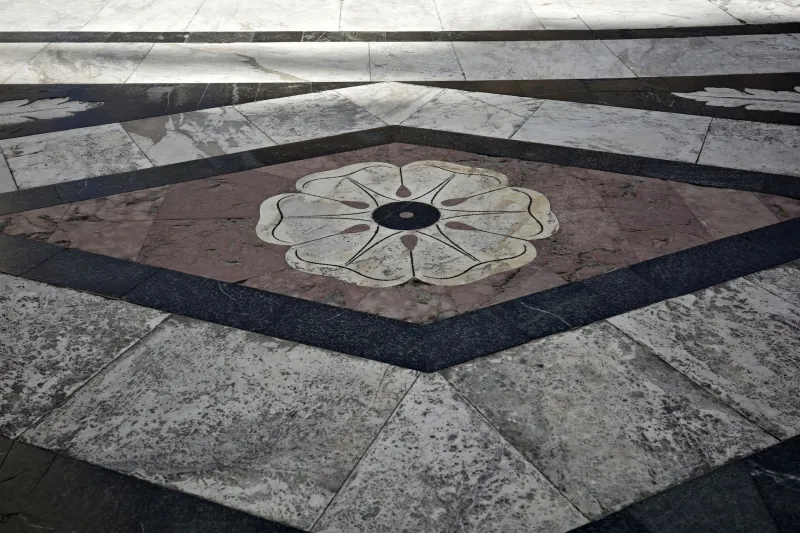
There is a square of floor in the middle of Westminster Abbey that almost nobody stands on and almost everybody walks past. It lies in the choir, directly before the high altar, and it is made of thousands upon thousands of small cut pieces: purple porphyry, green serpentine, dark marble, pale limestone, and glass of a blue that seems to hold light rather than reflect it. Bands of pattern coil across it and roundels interlock, and around the whole field runs a border of brass letters, worn now to a whisper, in which a thirteenth-century Latin verse speaks of the spherical globe, of the threefold and the sevenfold, of elements reconciled into one body. It is the great pavement, and it is one of the finest survivals of Cosmati work north of the Alps.
A floor built to outlast its builders
The pavement was laid in 1268 by command of Henry III, carried out by craftsmen summoned from Rome who worked in the manner we have since named after the Cosmati family of marble-workers. Their method was not the picture-making of later church art but something more architectural: geometry, number, and the deliberate collision of rare stones. Nothing about it is hurried. A tesserae is cut to no standard size, only to the gap it must fill. Lime mortar is mixed, left, and mixed again. The design is first drawn out full-size on a cartoon — a working drawing on paper or plaster — and then abandoned to the floor, where it will be judged by feet rather than by eyes.
For much of its life the pavement disappeared beneath a carpet. It was re-exposed in the nineteenth century, and between 2008 and 2010 it was studied, cleaned and made stable. Even now its surface rises and falls like a field after rain. Pieces are missing. Repairs appear in stones that do not match. No photograph quite prepares you for how uneven it is, or how much of its beauty is a matter of repair rather than of original finish.
The prayer that refuses an audience
Matthew 6:5–8 is the passage to read on your knees beside it. Jesus begins with a warning about actors — the word behind our translation is the one used of players on a stage — who pray standing in the synagogues and at the street corners so that they may be seen. He does not forbid public prayer; he himself prays in public. What he forbids is prayer with a gallery in mind. Go into your inner room, shut the door, and pray to your Father who is in secret. And do not heap up phrases, he adds, as though volume or verbosity might wear down a reluctant deity: your Father knows what you need before you ask him.
Set that beside a mosaic. The men who cut and set the Westminster pavement were not named on it. Their work was covered for centuries. They laboured on hands and knees in poor light, matching one small stone to another, with no audience except the Lord and the next man along the bench. That is not a bad description of intercession. Most of the prayer offered in Britain this week will be offered in kitchens, on buses, in hospital corridors and in the ten minutes before a shift. None of it will be recorded. All of it is being set into something.
The worn places are the record
Look closely at the pavement and you notice that the wear is uneven. Certain paths have hollowed; others remain comparatively sharp. The floor has kept a physical memory of where people actually walked, which is rarely where a designer intended them to walk. Something similar happens to a life of prayer. The places we return to most often — the same few names, the same unfinished request, the same wordless ache — become the worn tracks in us. The mosaic tradition has a name for this too: the surface is not damaged by use, it is completed by it.
A secret mosaic for an ordinary week
What might this look like on a Tuesday in November? Consider a small discipline, unglamorous and easily hidden — a secret mosaic of intercession.
- Choose seven. Not seventy. Seven people, situations or places, written in the back of a notebook that nobody else need ever read. Treat the notebook as your cartoon: the full-size design from which the work is set.
- Keep one tessera. A single small stone in a coat pocket or beside the kettle. Its only purpose is to be touched, and to remind you that the work has begun.
- Give it five minutes, at a fixed hour. The same chair, the same window, the same seven names. No phrases are required. The Father knows what you need before you ask.
- Gather the week. On a Sunday, review the seven. Add one name, release one, and note anything that has changed. This is the gathering-up, the sorting of the fragments into a pattern you can only see from a distance.
The Cosmati craftsmen never saw the whole floor at once. They saw a cartoon, a mortar bed, and the next stone. That is enough. Prayer offered behind a shut door is never wasted, and never unseen; it is being laid into a pavement whose pattern belongs to the One who sees in secret, and who rewards openly what was done in hiding.
Before you next stand in a great church, spare a glance for the floor. The most important work in the building is usually the part everyone steps over.