Twelve Baskets in the Trolley: John 6:12 and the Mosaic of the Fragments
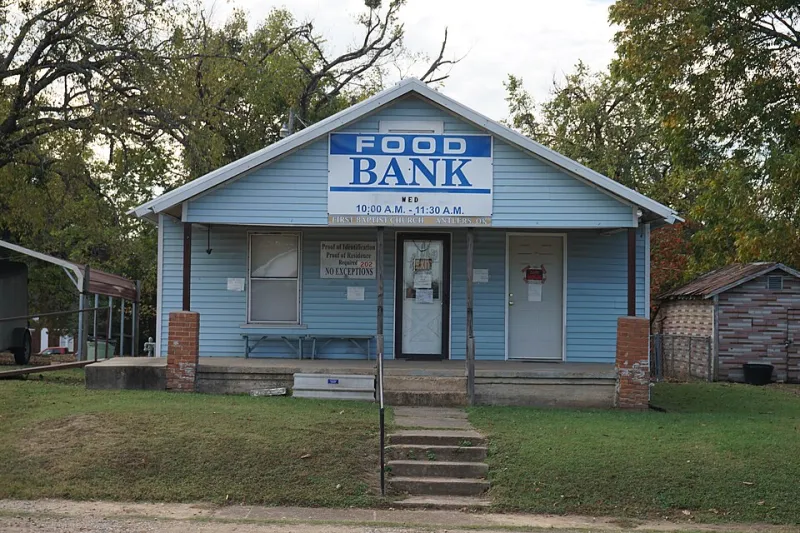
Photo: Michael Barera, CC BY-SA 4.0, via Wikimedia Commons
The hall smells faintly of floor polish and oranges. Two trestle tables have been pushed together, and on them the morning’s delivery is being unpacked: tins of tomatoes, tins of rice pudding, tins of soup with the labels peeling at one corner. A woman in a fleece checks dates with a biro in her hand. A retired teacher stacks pasta into crates by shape. Somebody’s teenager is sent to find more carrier bags, and the kettle goes on for the fourth time. Outside, it is the sort of November morning that makes the church porch look like a refuge.
This is a scene repeated in hundreds of church halls across the United Kingdom every week. Food banks have become one of the most visible forms of Christian presence in ordinary British streets — run from vestries, community centres and Baptist church basements, staffed largely by people who would not describe themselves as activists, motivated by something older than policy.
A verse at the bottom of a carrier bag
John’s account of the feeding of the five thousand ends with a detail that the other Gospels leave out. After everyone has eaten, Jesus tells his disciples: ‘Gather up the fragments that remain, that nothing may be lost.’ They do, and they fill twelve baskets. The abundance is not simply that there was enough; it is that the leftovers outweighed the original provision, and were counted worth keeping.
That instruction is a strange one to read in a food bank queue. The people waiting are not fragments. They are not surplus, not the by-product of an economy that has overproduced. But the language of gathering, sorting, keeping and not wasting maps almost too neatly onto what happens in that hall. The tins have been gathered from supermarket collection points, school harvest assemblies and the back of somebody’s cupboard. The volunteers sort and date and shelve them. Nothing is thrown away that can be used. The whole enterprise is an argument, made in metal and cardboard, that nothing and nobody should be lost.
Every tin a tessera
A tessera is a small cut piece of stone or glass, deliberately shaped and set beside others to make a pattern it could never make alone. Held between finger and thumb, it is unremarkable. Set in the bed, it becomes part of a face, a wing, a river.
A food bank is a mosaic in precisely this sense, and it is worth naming the tesserae out loud, because most of them are invisible from the pavement:
- The tin, bought on a two-for-one offer by someone who did not need it.
- The label, printed in a factory, carried home, then read by a volunteer checking a date.
- The shift, given up on a morning when it would have been easier to stay in bed.
- The voucher, the referral, the quiet conversation at the desk about a gas bill.
- The carrier bag, kept, folded, and handed over again.
- The prayer said over a crate by someone who never mentions it.
No single piece is impressive. Set together, they produce something that looks, from a certain angle, like the twelve baskets: an abundance assembled entirely from what other people thought was spare.
A workshop of fragments
Many churches would like a visible sign of this ministry — something in the porch or the welcome area that says what the crates are for. Here is a simple, low-cost idea that a small team could run over an autumn term, and which works well with children, with lunch clubs, and with the volunteers themselves.
The fragments panel. Ask volunteers to save clean tin labels from empty tins — the paper wrappers only, never the tins themselves, and never anything sharp. Soak the labels briefly in warm water so that they lift away intact, then press them flat between sheets of newspaper under a board for a week. Cut the dried labels into squares, roughly one to two centimetres; a paper trimmer does this quickly and safely, and children can tear rather than cut if preferred. Draw a simple design on a board or a sturdy piece of mount card — a basket, a fish, a loaf, a single word such as gathered — and fix the squares in place with PVA glue, working section by section as a mosaicist would. Seal the finished panel with a coat of diluted PVA once dry. Fix it to a wall and add a short caption with John 6:12.
The result is not fine art. It is better than fine art: it is a record of a local congregation’s actual week, made from the packaging of its own giving, and legible to anyone who has ever stood in the queue.
The harder work of welcome
A mosaic, however good, is not the ministry. Two cautions deserve saying plainly.
First, hospitality is not a transaction. The most common complaint from people using food banks is not the quality of the tinned goods but the atmosphere at the desk. A church that hands over a bag without a chair to sit on, a hot drink, or a person willing to listen has built a dispensing point, not a welcome. The volunteer who learns a name is doing more than the volunteer who restocks a shelf.
Second, waste and want sit side by side in the same economy. It is right to gather fragments; it is also right to ask why so many fragments were needed. Churches engaged in food provision increasingly pair practical help with advice services, cash-first approaches and quiet advocacy. Bread and justice are not rivals.
The counting at the end
At the close of a shift, the crates are counted and the numbers written in a book. Somewhere in that arithmetic is a question the Church has been answering for two thousand years: what is a fragment worth? The answer given on a Galilean hillside was not a shrug but an instruction. Gather them up. Count them. Set them in place. Nothing is to be lost.
If your church runs a food bank, the panel on the wall is the easy part. The mosaic is what happens in the hall between nine and twelve, when someone whose name you now know takes a chair, a cup of tea, and a tin of tomatoes, and is treated as a piece with a place in the pattern.