A Net Is Not a Frame: St Andrew and the Holy Rearrangement of Vocation
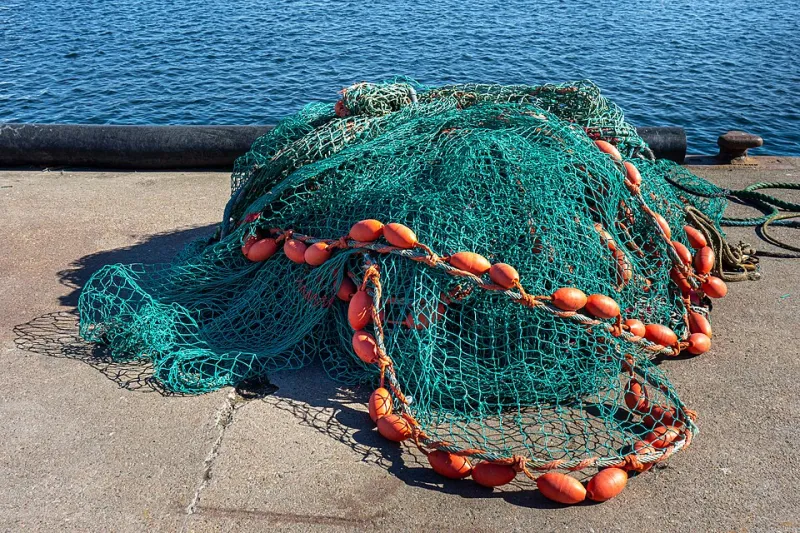
Photo: W.carter, CC BY-SA 4.0, via Wikimedia Commons
St Andrew's Day is a fixed point in the Scottish calendar, and in 2026 it falls on Monday 30 November. It arrives at the end of the Church's year, when the light is low, the evenings are long, and many congregations are already thinking about Advent. That timing gives the feast a particular texture. It is not a bright midsummer festival but a late-November invitation to consider vocation in the grey and the ordinary. The Gospel reading most closely associated with Andrew is not a story of tidy certainty. It is a story of nets, boats, labour and interruption.
A Grid Held in Working Hands
In Luke 5, Jesus stands by the Lake of Gennesaret and sees two boats at the water's edge. The fishermen are washing their nets. They have worked through the night and caught nothing. Jesus gets into Simon's boat, teaches the crowd, and then tells Simon to put out into deep water and let down the nets for a catch. Simon answers with the weariness of a man who knows the lake: 'Master, we have worked all night long but have caught nothing. Yet if you say so, I will let down the nets.' The catch that follows is so large that the nets begin to break and the boats begin to sink.
Mark 1 tells the same calling more briefly. Jesus sees Simon and Andrew casting a net into the sea, for they were fishermen. He says, 'Follow me and I will make you fish for people.' Immediately they leave their nets and follow him. The brevity can make the scene sound effortless, but the Luke account reminds us that these are not empty-handed men. They are people with equipment, obligations, fatigue and a trade. Their nets are not props. They are the instruments of a working life.
That detail matters for how we speak about Christian calling. A net is not a frame. A frame encloses a picture and declares it finished . A net is a working grid: it is cast, drawn, repaired, moved and cast again. It is designed for repetition and adjustment. It belongs to the rhythm of labour rather than the finality of display. When Christ calls fishermen, he does not first ask them to hang their nets on a wall as a memorial to their former lives. He enters the working grid and begins to rearrange it.
The Saltire and the Shape of a Calling
Scotland's national flag carries the cross of St Andrew, the saltire. Tradition connects the symbol with a battle near Athelstaneford in the ninth century, where a cloud formation is said to have appeared in the shape of a cross. Whatever weight we give that story, the saltire has become a familiar sign of identity and place. It is simple enough to be recognised at a distance and flexible enough to appear on flags, church banners and everyday objects.
There is a useful modesty in that simplicity. The cross of St Andrew does not present a closed picture of Scottishness or of discipleship. It is a sign that has been carried into many different contexts and has been allowed to mean more than one thing at once. In a similar way, the mosaic artist does not begin with a finished image and then surround it with a frame. The artist begins with many small pieces and arranges them until a pattern emerges. The pattern is real, but the pieces remain distinct. The grout lines remain visible. The work depends on the spaces between the stones as much as on the stones themselves.
Andrew himself appears in the Gospels as a person who brings others to Jesus. In John 1 he brings Simon Peter. In John 6 he brings a boy with five barley loaves and two fish. He does not dominate the narrative, but he is repeatedly placed at the edge of a larger gathering, making an introduction. That is a mosaic vocation: not the whole picture, but a necessary piece in the pattern by which others are brought near.
What the Net Does Not Do
A net does not guarantee a catch. Luke is careful to show that the fishermen had worked all night and caught nothing. The abundance comes after the word of Christ, not as a reward for technique. This is a necessary correction for congregations tempted to measure vocation by visible results. The net is not a machine for controlling outcomes. It is an instrument of faithful labour, and its usefulness depends on being cast where Christ directs.
Nor does a net remain unchanged. Nets are repaired. Knots are retied. Tears are mended. A fisherman who refuses to adjust the net will soon find that it cannot hold what it is meant to hold. The same is true of the patterns by which we serve Christ in local churches. A form of ministry that once gathered people may need to be repaired, recast or set aside. A building that once served one pattern of community may need to be rearranged for another. A tradition that once carried the Gospel faithfully may need to be handled with care and allowed to breathe in a new season.
This is not a argument for constant novelty. It is an argument for attentiveness. The mosaic artist does not rearrange tesserae for the sake of change. The artist moves pieces because the image requires it. The goal is not a different pattern for its own sake, but a truer pattern. In the same way, the Church is called to let Christ rearrange the grid of its common life so that the Gospel is not obscured by habits that have become frames rather than nets.
Mosaic Lessons for a Late-November Congregation
As 30 November 2026 approaches, congregations in Scotland and across the UK might use St Andrew's Day as a small devotional hinge between the end of the year and the beginning of Advent. The reading does not demand a grand plan. It asks for a willingness to let Christ enter the ordinary work we are already doing.
A local church might begin with a simple question: what are the nets we are actually holding? Not the nets we wish we were holding, or the nets we imagine a more impressive congregation would hold, but the real instruments of our common life. A rota. A weekly food collection. A quiet midweek service. A churchyard that neighbours walk through. A hall that hosts a toddler group. A person who makes the tea after worship and knows which newcomer needs to be introduced. These are not frames around a finished picture. They are working grids, and Christ can use them.
The mosaic dimension is important here. A mosaic is made of many pieces that do not compete for attention. Each tessera has its own colour and edge, but the beauty belongs to the whole. St Andrew's calling was not to become the whole picture. It was to follow Christ within a pattern that included others. That is a freeing truth for Christians who feel that their contribution is small or hidden. The small piece is not less necessary because it is small. It is necessary because the pattern requires it.
Leaving Room for the Rearrangement
St Andrew's Day is a fitting moment to pray for the grace of rearrangement. The net is not a frame. The saltire is not a cage. The mosaic is not a monument. All three point towards a discipleship that is willing to be moved by the hand of Christ. In Luke 5, Simon falls at Jesus' knees and says, 'Go away from me, Lord, for I am a sinful man.' Jesus does not dismiss him. He tells him not to be afraid and gives him a new work. The call does not begin with a finished person. It begins with a person who is willing to let the net be recast.
As the November light fades and Advent draws near, that is a good prayer for UK congregations. Lord, enter the ordinary grid of our work. Repair what has torn. Move what has become a frame. Gather what we cannot gather. And let our small pieces become part of the pattern you are making.