The Gardener’s Subtraction: John 15 and the Grace of Being Cut Back
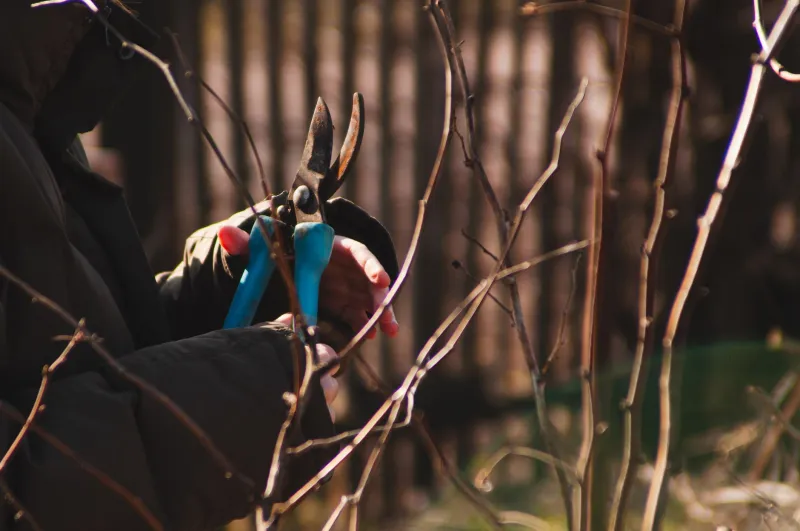
As November 2026 settles over the allotment, the last colour drains from the apple tree and the blackcurrant bushes. What remains is a spare black sketch against a grey sky: stripped stems, a few dry leaves, the ghost of summer’s abundance. To the casual observer, the plot looks finished. The gardener, however, arrives with secateurs, not condolences. In the late-autumn garden, pruning is not an interruption of growth but one of its necessary conditions.
That is the world Jesus borrows in John 15. He does not begin with fruit, but with a vine and a vine-grower. 'I am the true vine, and my Father is the vine-grower,' he says. 'He removes every branch in me that bears no fruit. Every branch that bears fruit he prunes to make it bear more fruit' (John 15:1–2). The image is agricultural, ordinary and, at first hearing, severe. Yet the severity belongs to a gardener’s care, not to a judge’s rejection.
The Allotment in November
British gardeners know the discipline of the cut-back season. Fruit trees are trained and thinned; roses are reduced; old wood is taken out so that light and air can reach what remains. The Royal Horticultural Society’s calendars are full of such work in late autumn and winter, and anyone who has kept a plot through a wet November knows how unglamorous it is. There is no immediate harvest to admire. The reward is hidden in next year’s bud.
John 15 gives theological shape to that hiddenness. The Father is not a distant owner who inspects the vineyard from a warm office. He is the vine-grower, attentive to the branch. Pruning is not neglect; it is a form of reading the plant rightly. The branch that is cut back is not being told that it is useless. It is being prepared for a fruitfulness it cannot yet display.
What the Secateurs Say
A good pruner does not saw at random. The work is selective. Crossing branches are removed before they rub and wound. Diseased wood is taken out before it spreads. Suckers that drain energy from the main stem are cut away. The aim is not to make the tree smaller for its own sake, but to make it healthier and more fruitful.
The spiritual analogy must be handled with care. Not every hardship in a Christian’s life is a divine pruning, and it is pastorally reckless to tell a sufferer that God has simply been cutting them back. John 15 is not a universal explanation for pain. It is a promise about the vine-grower’s intention towards branches that remain in the vine. The text places the emphasis on abiding, not on interpreting every loss as a lesson.
Even so, the image invites honest examination. There are habits, attachments and ambitions that quietly drain the life of discipleship. There are commitments that once served the gospel and now merely occupy ground. The word of Christ, says John 15:3, is the instrument of cleansing: 'You have already been cleansed by the word that I have spoken to you.' Pruning begins with listening to that word, not with a programme of self-improvement.
Tesserae Chosen, Tesserae Set Aside
Mosaic-makers understand a similar discipline. A tessera is selected, cut to shape and set into the design. But not every piece is used at once. Some are set aside because they belong to another section of the cartoon, or because their colour will only make sense when the surrounding stones are in place. The set-aside piece is not waste. It is material held in readiness.
Pruning has that quality of holy patience. What looks discarded in November may be the very thing that serves the design later. The branch is not asked to produce fruit by force. It is asked to remain connected to the vine. 'Abide in me as I abide in you,' says Jesus. 'Just as the branch cannot bear fruit by itself unless it abides in the vine, neither can you unless you abide in me' (John 15:4).
In mosaic work, the setting bed matters as much as the stones. The tesserae do not hold themselves together; they are held. In the same way, Christian fruitfulness is not a matter of straining to be impressive. It is a matter of being held in Christ, and of letting the ordinary means of grace—Scripture, prayer, the sacraments, the fellowship of the local church—do their slow work.
Abiding Is Not Achieving
November is a useful corrective to a culture that measures everything by visible output. Churches, too, can absorb that culture. We count attendance, volunteers, budgets and programmes, and we can begin to read a bare season as a failed season. John 15 offers a different arithmetic. The branch’s first calling is not to produce, but to remain.
That does not make discipleship passive. Abiding is an active dependence, a daily turning towards Christ. It is the gardener’s trust expressed in the plant’s continued life. 'Those who abide in me and I in them bear much fruit,' says Jesus, 'because apart from me you can do nothing' (John 15:5). The sentence is not a threat. It is a liberation from the illusion that the branch is the source of its own life.
Fruit That Belongs to the Future
John 15 speaks of fruit, and the New Testament elsewhere fills out what that fruit looks like: love, joy, peace, patience, kindness, generosity, faithfulness, gentleness and self-control. These are not the sort of results that can be rushed into being. They grow in the soil of abiding, often through seasons that feel more like reduction than increase.
For many congregations in the UK, this November may feel bare. Numbers may be thin; volunteers may be tired; the building may need work; the diary may look less full than it once did. None of that is automatically a sign of divine displeasure. The vine-grower is patient, and the mosaic is not finished while any tessera is still waiting to be set. The bare branch is not outside the design. It is part of it.
As Advent approaches, the Church is invited to practise the gardener’s subtraction: to let go of what cannot bear fruit, to receive the cut-back season as a place of preparation, and to abide where Christ has placed us. The secateurs are not the end of the branch. They are the gardener’s confidence that fruit belongs to the future.
A Prayer for the Pruned
Lord Christ, true vine, keep us in you when the leaves are gone and the fruit is hidden. Give us grace to receive the gardener’s careful work without mistaking every cut for abandonment. Teach us to abide in your word, to rest in your love, and to wait for the fruit that belongs to your timing; through Jesus Christ our Lord. Amen.