Evergreen Witnesses: A Winter Walk Among Britain’s Churchyard Yews
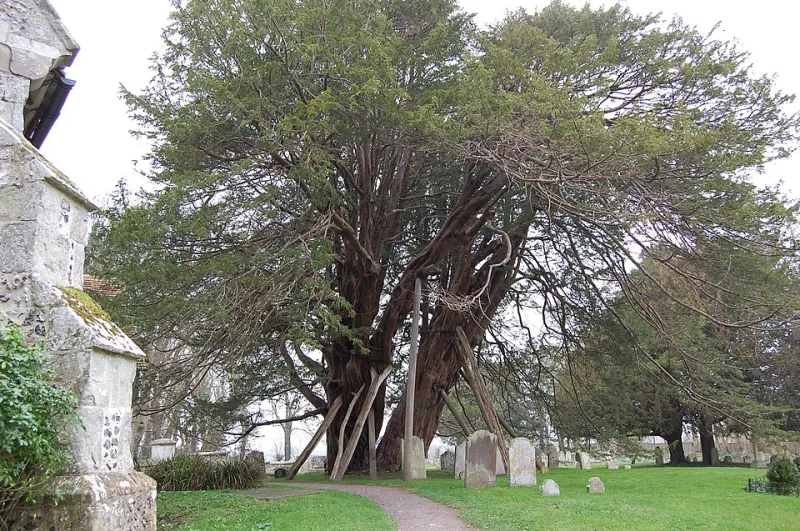
Photo: Julian P Guffogg , CC BY-SA 2.0, via Wikimedia Commons
On a damp November afternoon, the churchyard yew does not immediately announce resurrection. It stands dark against pale stone, its needles holding a green that seems almost black. Rain gathers in the folds of its bark. The wind moves through it without hurry. Yet the yew is one of the most eloquent living signs in the British landscape: a tree that outlasts dynasties, remembers forgotten names and keeps watch while generations arrive and depart.
In the Christian imagination, the churchyard is already a kind of mosaic. Headstones are the obvious tiles, each one a life cut to a particular shape. But the yews are tiles too, larger and older, set into the picture by hands we cannot identify. From Borrowdale to Llangernyw, they teach a patient theology. They do not argue for resurrection so much as embody the kind of faithfulness in which resurrection becomes believable.
A Tree Outside the Clock
Most trees tell time by shedding. The yew does not. Its evergreen habit gives it a strange independence from the seasonal drama of autumn and spring. This is not because it ignores time, but because it grows according to a longer rhythm. A yew may add only a little girth in a century. It can regenerate from old wood. It can stand hollowed and still put out new shoots.
Scripture knows this language. Job 14:7-9 speaks of a tree that is cut down yet sprouts again: ‘at the scent of water it will bud.’ Psalm 92:12-14 compares the righteous to trees planted in the house of the Lord, still bearing fruit in old age. These are not simple nature poems. They are acts of theological imagination, teaching God’s people to see endurance as a form of praise.
The yew also resists our impatience. We tend to look for resurrection as a sudden reversal, a stone rolled away in a single morning. The yew suggests that resurrection is also God’s long refusal to abandon the ground. It is the quiet persistence by which life is kept in store, season after season, until the day of unveiling.
Seven Tiles in a Long Picture
A list of ancient yews is not a league table. Ages are debated, and the oldest estimates should be handled with humility. But these seven churchyard yews offer a practical map for readers who wish to notice the living mosaic of British Christian history.
-
Llangernyw, Conwy. The yew at St Digain’s is often described as one of the oldest living things in Wales. Its age is contested, but its presence is not: a vast, ancient witness in a quiet village churchyard.
-
Fortingall, Perthshire. Set in a former churchyard in Perthshire, the Fortingall yew is among the most famous ancient yews in Britain. What remains today is a fragment of a much larger story, and that fragment is enough to inspire wonder.
-
Defynnog, Powys. The yew at St Cynog’s, Defynnog, stands in a landscape of lanes and hills where centuries of worship have left their mark. It is a reminder that holiness is often local before it is national.
-
Borrowdale, Cumbria. The Borrowdale yews, associated with the churchyard at Rosthwaite, belong to a valley where rock, water and weather shape the imagination. They are tiles set not only in a churchyard but in a whole creation.
-
Much Marcle, Herefordshire. The yew at St Bartholomew’s, Much Marcle, is a hollowed and weathered presence, the kind of tree that makes a churchyard feel like a room with a very old ceiling.
-
Stoke Gabriel, Devon. In the churchyard of St Mary and St Gabriel, near the Dart, a ancient yew gives the village a centre of gravity. It is the sort of tree that teaches children to look up and adults to slow down.
-
Gresford, Wrexham. The yew at All Saints, Gresford, belongs to the borderland where Welsh and English histories meet. Its reputed antiquity is less important than its ordinary work: standing where the faithful gather, keeping a green witness through every season.
What the Evergreen Preaches
The yew does not replace Scripture; it accompanies it. When Paul writes in 1 Corinthians 15:42-44 about the body sown in weakness and raised in power, he reaches for the language of seed and transformation. The churchyard yew is not the resurrection itself, but it is a parable of the patience that resurrection requires of us.
This matters for pastoral life. Many Christians carry prayers that have not yet been answered, griefs that have not yet been healed, churches that feel reduced to a stump. The yew speaks a cautious word of hope: not that nothing has been lost, but that God is not finished with the ground. The tree can be hollow and still alive. A congregation can be small and still be a place where Christ is present.
There is also a mosaic lesson here. A mosaic is not made of identical pieces. It depends on contrast: dark and light, rough and smooth, large and small. The churchyard holds together the newly bereaved and the long-dead, the Victorian tablet and the medieval font, the yew and the snowdrop. Each tile is particular. Together they witness to a faithfulness larger than any single life.
A Prayerful Walk This Winter
Readers need not travel to famous trees. The most important yew may be the one in the parish churchyard at the end of the road. A prayerful walk can be simple and unhurried.
Begin at the gate. Read Psalm 121 slowly, noticing the hills or rooftops beyond the churchyard. Walk to the oldest tree you can find and stand at a respectful distance. Read Psalm 92:12-14. Consider one thing in your life that feels cut down, and one thing that still shows green.
Move to the porch or doorway of the church. Pray for those who keep the building open, those who clean it, those who preach and those who cannot attend. Then walk once around the churchyard, not reading every stone, but noticing the mosaic: a name, a date, a carved leaf, a patch of moss. End with the Lord’s Prayer.
Practical care matters. Many churchyards are open, but some are fragile or have unsafe trees. Keep to paths, do not climb or damage roots, and remember that yew is toxic to people and animals. A churchyard is a place of worship and memory, not a playground or a foraging site.
The Tile You Leave Behind
Winter is a good time to see the yew clearly, when the deciduous trees have undressed and the churchyard is stripped back to stone and evergreen. It is also a good time to remember that our own lives are tiles in a picture we will not fully see. We are not asked to complete the mosaic. We are asked to take our place in it with patience.
The yew keeps its green through frost and fog. It does not explain itself. It simply stands, year after year, as if to say that the God of resurrection is not in a hurry, and that the ground of our churchyards is already held in hands that do not let go.