The Carpet Page as Mosaic: Lindisfarne and the Discipline of Holy Slowness
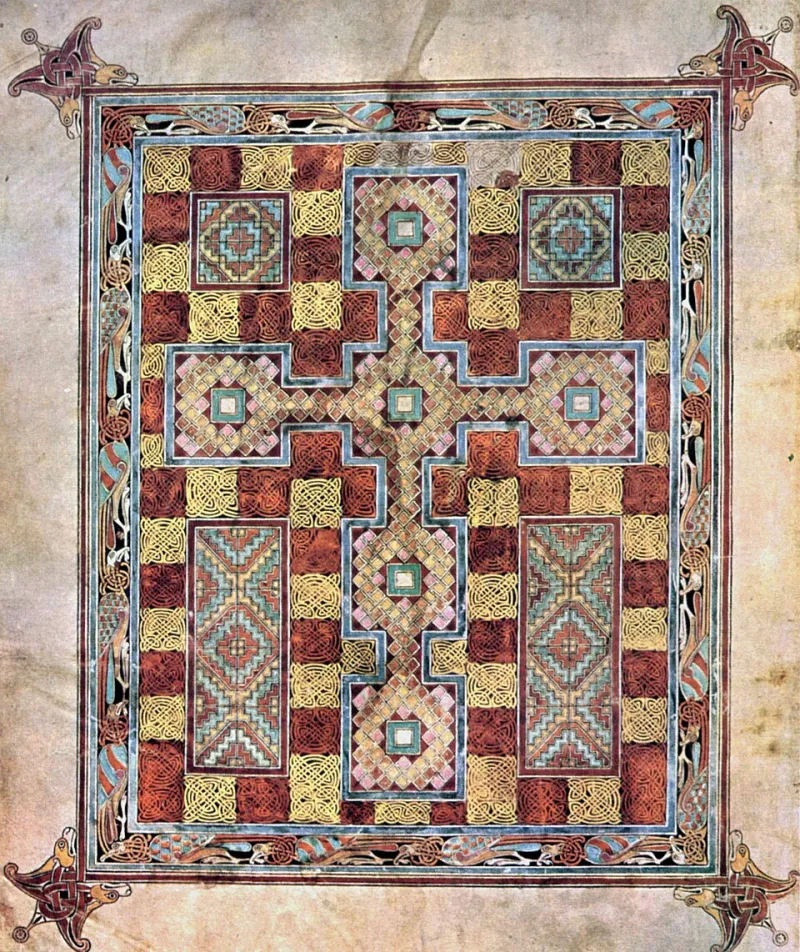
Photo: Meister des Book of Lindisfarne, Public domain, via Wikimedia Commons
The Lindisfarne Gospels are usually described as a masterpiece of Insular art: a seventh-century manuscript made on Holy Island, now held in the British Library. Its carpet pages, evangelist portraits and intricate interlace are justly famous. Less often noticed is how much the book resembles a mosaic. It is not made of stone or glass, but of coloured ink, vellum, geometry and patience. Each small decision is a tile. Each page is a field in which the eye is asked to move slowly.
For readers accustomed to scrolling, the manuscript can feel almost inconvenient. There is no quick summary. A carpet page does not deliver its meaning in a single glance. It requires the kind of attention a mosaic-maker gives to grout lines and shadow. This is not an obstacle to devotion; it may be one of the manuscript’s most useful gifts.
A Mosaic Made of Ink
The Lindisfarne Gospels were probably made around the year 700 at the monastery of Lindisfarne, in the kingdom of Northumbria. Tradition associates the work with Eadfrith, bishop of Lindisfarne, though the manuscript also carries later additions and a famous colophon by Aldred, a priest who glossed the Latin text in Old English. The book is a Gospel book, but it is also a visual sermon.
The carpet pages are the clearest link to mosaic thinking. They are pages of pure pattern, without narrative scene or text, filled with interlace, spirals, animals and crosses. They do not illustrate a verse so much as create a space in which the reader must stop. The eye follows a line, loses it, finds it again. The pattern is not chaos; it is ordered complexity. In that sense it is close to a mosaic floor or wall, where individual pieces surrender their separateness to a larger design.
This matters for how we approach Scripture. We often treat the Bible as a text to be mastered, a set of propositions to be extracted. The Lindisfarne Gospels suggest another posture: receiving the Word as something given to be inhabited. The book is not merely a container for words. It is an act of worship, made slowly, with materials that took time to prepare and skill that took years to acquire.
The Patience of the Interlace
Interlace is a good teacher because it frustrates haste. A line disappears under another, reappears, turns back on itself. The pattern is coherent, but it is not linear in the way a modern argument is linear. To read it well, the eye must slow down and accept that understanding will come through repetition rather than force.
Psalm 119 is the Bible’s great meditation on this kind of attention. ‘Open my eyes, that I may behold wondrous things out of your law’ (Psalm 119:18). ‘Make me understand the way of your precepts’ (Psalm 119:27). ‘Your word is a lamp to my feet and a light to my path’ (Psalm 119:105). The psalm does not rush toward a conclusion. It circles, repeats, returns. It is itself a kind of interlace, weaving desire, memory, obedience and hope into a single long prayer.
Colossians 3:16 gives the practice a communal shape: ‘Let the word of Christ dwell in you richly.’ The word ‘dwell’ matters. A mosaic is not assembled in a moment, and a dwelling is not built in a day. The Lindisfarne artists did not make a book to be consumed in one sitting. They made an object that would be returned to, handled, kissed, processed and pondered. Slow reading is not a modern wellness technique. It is an older Christian instinct.
Reading Scripture Tile by Tile
A mosaic-maker works with small pieces because the whole is too large to hold at once. The same principle can shape our reading. Instead of trying to cover a long passage quickly, we can choose a short portion and receive it as a series of tiles.
A simple method has four tiles. The first is the word tile: read the passage aloud slowly and notice one word or phrase that catches your attention. Do not explain it yet. Simply receive it.
The second is the image tile: ask what picture, memory or feeling the passage stirs. The Lindisfarne carpet pages teach us that images are not decorations. They are ways of allowing truth to settle in the imagination.
The third is the prayer tile: turn the word or image into a short prayer. This need not be eloquent. ‘Lord, make this true in me’ is enough.
The fourth is the neighbour tile: ask who might need this word today. A mosaic is made for a community, not for a private collector. Scripture read slowly should eventually turn us toward others.
A Practice for Advent or Ordinary Time
This practice can be used in Advent, when the Church waits for the coming of Christ, or in ordinary time, when the routine of discipleship needs renewing. Choose a Gospel passage that is short enough to hold: the opening of John’s Gospel, the Beatitudes, the annunciation to Mary, the road to Emmaus, or the resurrection appearance to Thomas.
Set aside fifteen minutes. Put away the phone. Read the passage three times, once for the ear, once for the eye and once for the heart. Then write one sentence on each of the four tiles in a notebook. If you miss a day, do not turn the practice into a new law. Return to the page. A mosaic is not ruined by one delayed tile.
UK readers who wish to see the manuscript itself can consult the British Library’s digitised images, and some may be able to visit exhibitions in London. But the practice does not depend on access to a rare book. The same discipline can be learned with an ordinary Bible, a quiet room and the willingness to read less in order to receive more.
The Page Still Open
The Lindisfarne Gospels are often admired as a national treasure, which they are. But they are also a pastoral gift. They show that Scripture has been read with patience before us, by people who did not confuse speed with faithfulness. Their carpet pages are not mere ornament. They are invitations to stop, to trace the line, to let the pattern become prayer.
In a year of noise, the manuscript’s lesson is plain. Read slowly. Read visually. Read as one who is making a mosaic and not merely collecting stones. The Word of Christ is rich enough to dwell in, tile by tile, for a lifetime.